
Placement · Published April 16, 2026 · Updated September 15, 2026
A gap is a measurement, not a verdict.
Doors that swing open, drawers that roll, and a shadow along the wall usually mean the floor, the wall, or the case is out of square. Those are three different fixes.

Nightstands and a shelf only look related if each one sits without rocking. The floor under them may not be one plane.
Is the floor level?
Set a level on the floor where the front feet will stand, then again where the back feet will stand, in both directions. Older houses often slope toward a wall. A case that is square will still show a gap at the floor or at the wall if you force all four feet into the same imaginary plane. The fix is to support the high or low foot, not to twist the case.
Is the case square?
If you assembled it, check the diagonals the way the assembly guide describes. A parallelogram rocks on two feet no matter how flat the floor is. Leveling feet will hide that for a day and then a door will bind. Correct the case before you add shims.
Is the wall flat?
Plaster and old drywall bow. A straight back panel will not kiss a bowed wall along its whole width. A gap in the middle, or at one end, can be the wall. Chasing it by loosening cams until the back bends will open joints you just closed. Anchor to the wall the instructions name, and let a small, even gap remain if the kit allows it.
Feet, then shims
Many cases have threaded feet. Turn a foot to lengthen that corner. Do not unscrew it until only a few threads hold. If the needed change is larger than the foot can travel, the floor is asking for a shim under the frame, not a foot hanging by a thread.
A shim is a thin wedge, plastic or wood, placed under the low side so the case stops rocking. Put it under a structural rail if you can, not under a thin toe-kick that will crush or show as a bright triangle. Slide it in until the rock stops, then mark it and trim the excess so it does not become a toe-stub. One shim at the low corner is often enough. A stack of folded cardboard compresses and the rock returns.
Check doors and drawers after the rock is gone, not before. A door that swung open on a slope may close properly once the case is level. If it still rubs, look at the hinge adjustment the instructions show. That is a different screw from the foot.
What “level” is for
You are stopping unintended motion: a drawer that creeps open, a door that will not stay, a piece that clicks when you lean on it. You are not required to make a 100-year-old floor read perfectly on a machinist’s level. Split the difference so the piece is stable and the doors behave. Write down which corner got the shim so the next person does not pull it out during a cleaning.
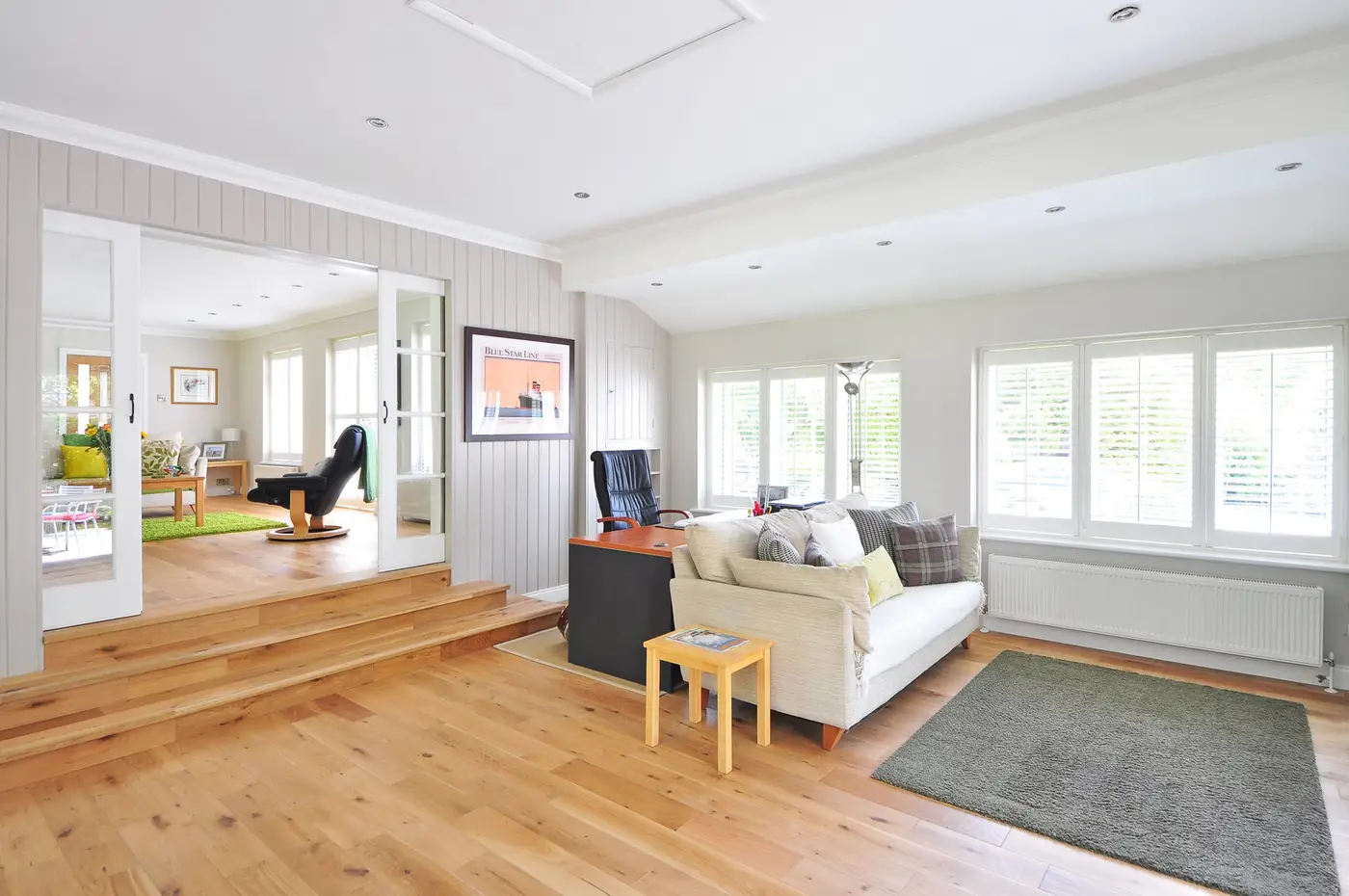
A change in floor height is not a defect in the sofa. It is a place to stop and reset the pads.

A sofa with fixed legs may have no threaded feet. Stability then depends on the floor and on glides, not on a shim stack that lifts one end into a slope.
The first weeks
Day of placement
Confirm all feet are touching or intentionally shimmed. Open every door and drawer once. Install the restraint if the instructions include one, after the piece is in its final inch. See wall anchoring.
First week
Wood moves when indoor humidity changes, especially in a newly heated or cooled room. A screw the instructions say you may retighten can be snugged. A cam that was already snug should not be cranked again “just in case.” If a joint opens, stop and look rather than adding force.
After a move of the piece
Any slide across the room can kick a shim out. Recheck rock, and recheck the restraint. A strap that fit at the old spot may be slack or twisted at the new one. In a rental, patch and permission questions are on the rental page.
When to stop adjusting
Stop if a panel is cracked, a cam spins without grabbing, or a foot has run out of thread. More rotation will not restore a stripped hole. The manufacturer or the seller who provided the piece is the path for a replacement part. This website does not stock parts and does not send someone to reset a hinge.
If the numbers were close before delivery, go back to the room sketch. A gap you cannot close may be the soffit, the baseboard, or a wall that was never flat. Forcing the case into that gap is how backs split.
Three gaps, three causes
A gap between the case and the floor, under one foot only, is usually the floor or a foot that is not down. A gap that is even along the floor and wide at the top against the wall is usually the wall, or a case that is not square. A door that hangs open on its own can be either. Check the floor with a level along the front feet and along the side feet before you decide the hinge is wrong.
Shims go under a foot the instructions allow you to support, and they should be the whole way under that foot, not a sliver that can walk out. Cardboard crushes. A stack of paper matches crushes. If the instructions specify an adjustable foot, use the thread before you add anything under it. When the thread runs out, stop. A taller glide from a different product is a guess.
After the piece sits level, open every door and drawer once. A drawer that binds on one side after leveling may have been fine while the case was rocking, because the rock was hiding a crooked slide. Fix the slide orientation from the booklet. Do not plane the drawer. Then, if a restraint is required, install it at this location. Moving the case “one more inch” after the strap is tight means doing the strap again. See wall anchoring.
Humidity and the first heating season
Indoor wood moves when the heat comes on and when a room that was closed up gets air conditioning. A small change in a door gap over a few weeks can be that movement. The page does not give you a seasonal schedule. It tells you what to recheck: feet still planted, shims still seated, doors still closing, restraint still fastened. If a joint has opened enough to see the dowel, stop adjusting and contact the manufacturer or the seller. This site does not supply replacement cams.